How is poker dice played? Basic rules
Poker is not the only game that can be enjoyed with a poker deck of cards. There are many other games that also tend to include other elements, such as dice, to establish turns or to determine the moves of the participants.
Typically, poker dice games are played with a dice cup, which cushions the impact of the dice and is designed to reduce the sound of them clashing when shaken together.
How to Play Poker with Dice

Poker dice games have always been part of humanity's history of play — at least for centuries. Despite the passage of time, many of them survive to this day and, despite some variations, continue to be enjoyed.
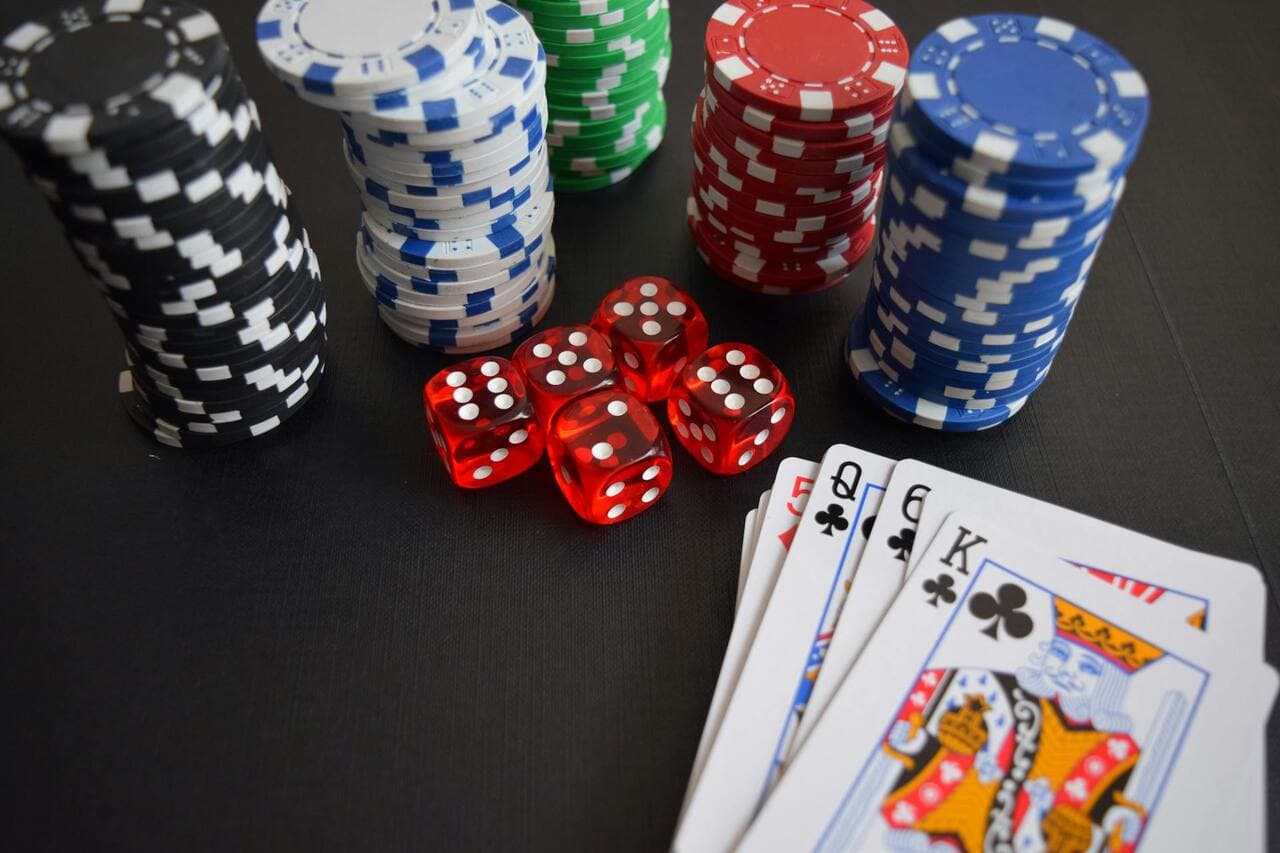
The undisputed king of these games is poker dice, and you'll only need two things to play: a set of five dice and a cup to roll them with. When we talk about dice, we mean poker dice — special dice that have, on some faces, dots; and on others, letters.
But how exactly do you play poker with dice?
Well, the objective of the game is simple: achieve the best hand to win and take the pot. The essence is the same as regular poker, except you play with dice instead of cards. To have a chance at winning, it's important that from your very first roll you land a solid dice combination to work with.
The 5-dice poker game mimics the five central cards used in a traditional poker hand. In other words, those five dice form your hand, which is what you'll be competing with. Just as in traditional poker, there is a hierarchy of combinations that determines the strength of your position when fighting for the pot.
Basic Rules of Poker Dice

In poker dice, the dice play a crucial role because they form a combination that determines how strong your hand is and your chances of taking the pot. These combinations are ranked by strength, as follows (from highest to lowest):
- Royal Poker. A combination of five dice all showing the same value. It is the strongest combination of all.
- Four of a Kind / Poker. A combination of four dice showing the same value. In traditional poker, the unmatched card acts as a kicker. In 5-dice poker, you may re-roll to try for a Royal Poker, though this depends on the variant you're playing.
- Full House. Formed by a combination of three matching dice and the remaining two forming a pair.
- Large Straight. Achieved by combining dice in sequential order: 2-3-4-5-6.
- Small Straight. Achieved by combining dice in sequential order: A-2-3-4-5.
- Three of a Kind. Like a Full House, but without the pair — three dice of the same value and two unmatched ones.
- Two Pair. A double pair, formed when two pairs of dice show the same value.
- One Pair. A standard pair — two dice showing the same value.
The rules also cover other aspects: number of rolls, betting limits, and the scoring system, which we'll look at in a few lines.
The number of rolls must be agreed upon in advance. It is fixed and cannot be changed until the game ends, in order to guarantee equal opportunities for all players. The standard is to allow between two and three rolls using the remaining dice that are not part of the player's current hand.
Here, good judgment is essential. It is the player who decides which dice to keep and which to re-roll. Keep in mind that:
- Keeping middle-value dice with 1 or 2 re-rolled dice: a good way to secure a decent combination, but it limits the range of combinations you can aim for.
- Discarding middle-value dice to try your luck again: riskier, but it allows you to go for a stronger combination without being tied to anything.
As for betting limits, poker dice games maintain a minimum and maximum cap applicable to all players and all bets.
How Scoring Works in Poker Dice

Some poker dice games use a scoring system that establishes the hierarchy among players. It works as follows.
- Standard (positive points). The option is set to award one point to whoever wins each round. Once the maximum number of rounds is reached (usually between 3 and 5), a winner is declared.
- Reversed (negative points). With this system, a point is added to a player each time they lose. When a player reaches the maximum number of points, they are eliminated and the game continues until, by process of elimination, only one player remains. This mode heightens the feeling of survival, but it must be made clear from the start whether there is a round limit or not.